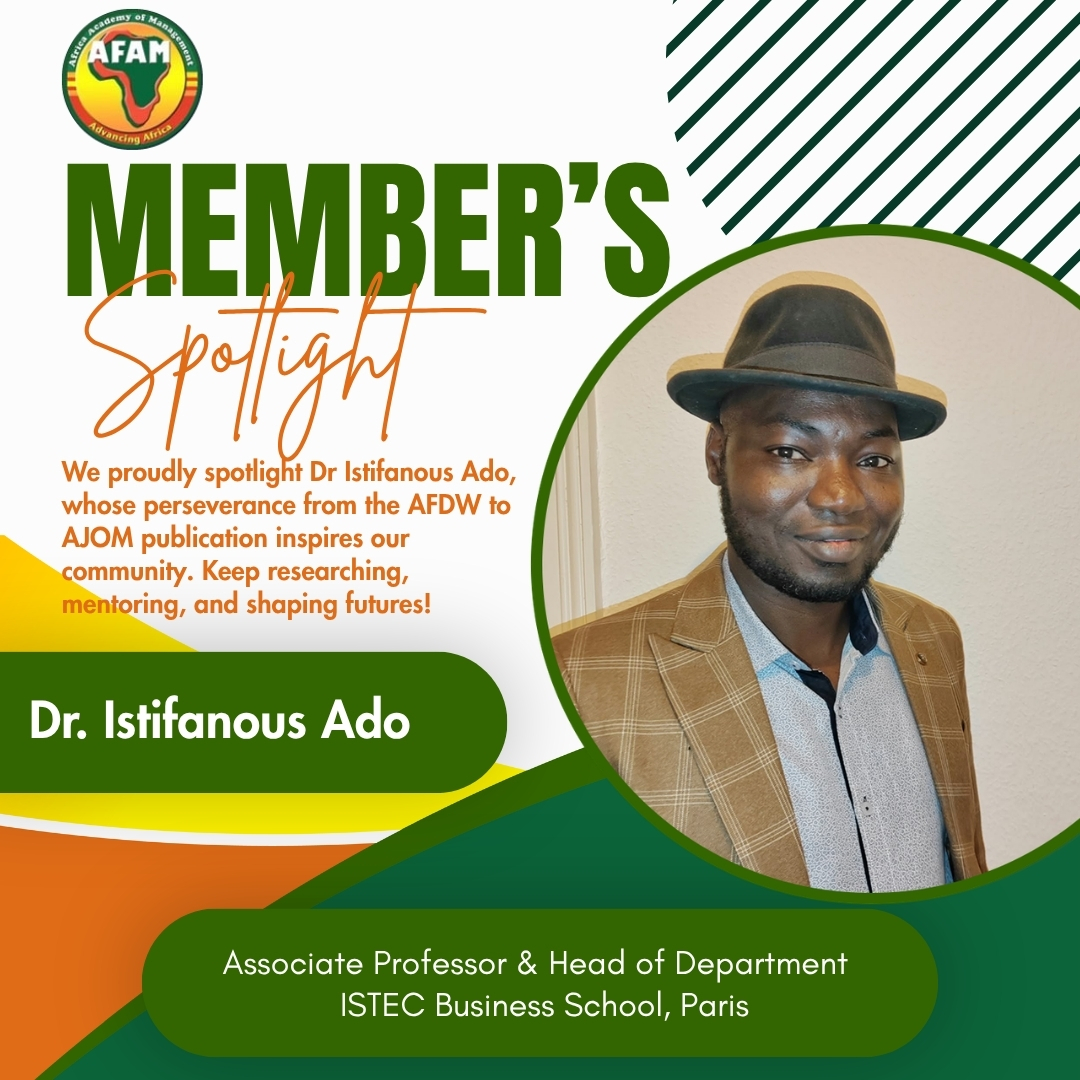
Head, Entrepreneurship & Innovation; Lead, Master in Entrepreneurship & Business Development
DBA, Horizon University, Paris · PhD in Management Sciences, Université Clermont Auvergne
Entrepreneurship · Leadership development · Informal economies · African business contexts · Diaspora studies
Professional Profile
Dr Istifanous Ado is an Associate Professor and Head of the Department of Entrepreneurship and Innovation at ISTEC Business School in Paris, where he also leads the Master’s specialisation in Entrepreneurship and Business Development. His teaching and research are grounded in entrepreneurship, leadership development, informal economies, institutions, ethics, and African business contexts.
Niger occupies a central place in his research — not only because of his personal and professional connection to the country, but because it offers important insights into broader questions of leadership, entrepreneurship, and development across the African continent.
Academic and Professional Journey
Dr Ado’s early publication experience was rooted in the French academic tradition. Trained as a French-speaking scholar, he developed his research practice within French-language journals and networks — valuable, but offering limited exposure to international English-language publishing or the global networks in which African management research is also discussed and developed.
The turning point came through Professor Mahamadou Biga-Diambeidou, who encouraged Dr Ado to look beyond his initial publication habits, introduced him to English-speaking scholarly networks, and connected him to the Africa Academy of Management (AFAM).
“His guidance helped me understand that publishing internationally did not mean moving away from African or French-speaking perspectives. On the contrary, it offered an opportunity to bring African realities, voices and questions into wider academic conversations.”
— Dr Istifanous Ado
Professor Biga-Diambeidou also consistently reminded Dr Ado that ethical rigour must remain non-negotiable in research — a principle that has shaped his scholarly identity ever since.
From the AFDW in Tunis to AJOM Acceptance
In June 2025, Dr Ado participated in the Africa Faculty Development Workshop (AFDW) in Tunis. At that stage, his manuscript was at the beginning of its development — he had conducted only five interviews, and the theoretical framing, empirical material, and overall contribution still required substantial work.
The AFDW proved transformative. What struck Dr Ado most was the combination of academic excellence, humility, and generosity he encountered:
“I met highly accomplished scholars who were genuinely willing to help junior researchers improve their work.”
— Dr Istifanous Ado
Professor Rachida Justo reviewed Dr Ado’s paper at the workshop and provided the first detailed, structured feedback he had received on the manuscript. Her comments helped him identify weaknesses, clarify the research focus, and strengthen the paper’s potential contribution — a foundation on which the rest of the journey was built.
After the workshop, Dr Ado continued the data collection, deepened the qualitative analysis, refined the theoretical framing, and clarified the study’s contribution. The manuscript later entered the AJOM review process, where reviewers and editors challenged him to deepen the findings, clarify the role of institutional absorptive capacity, reduce redundancies, and articulate more precisely the paper’s implications for leadership development in the Global South.
“The revisions did not simply improve the manuscript; they improved my capacity to think, write and engage with scholarly critique.”
— Dr Istifanous Ado
On 24 August 2026, the article was accepted. It is Dr Ado’s first publication in the Africa Journal of Management and, more broadly, his first publication in an English-language academic journal.
The Contribution of AFAM and Mentorship
For Dr Ado, AFAM was important not only as a workshop organiser, but as a scholarly community — one that provided access to mentorship, constructive feedback, and a network of researchers committed to strengthening African scholarship.
Through AFAM, he also connected with Professor Julie Nyanjom, whose expertise in qualitative research and genuine willingness to support emerging scholars have been an ongoing source of guidance. Her advice has become a guiding principle:
“Ado, build a publication plan that you can commit to every year, and be persistent.”
— Professor Julie Nyanjom, to Dr Ado
The experience reinforced Dr Ado’s conviction that structured mentorship is essential — especially for early-career African scholars entering international publication spaces: “A promising manuscript rarely becomes publishable through individual effort alone. It needs rigorous feedback, intellectual generosity, ethical guidance and a community that helps the author see what can be improved.”
Dr Ado intends to remain actively involved in AFAM and, as his own experience grows, to support future AFDW participants in turn.
The Accepted Article
“Leadership Development in the Global South: Insights from the Nigerien Diaspora” examines how members of the Nigerien diaspora develop leadership capacities and seek to contribute to leadership development in their country of origin.
The study highlights the diaspora not simply as a source of remittances or technical expertise, but as a potential reservoir of leadership knowledge, international experience, and institutional resources — and shows that the transfer of leadership practices depends on relationships, trust, institutional conditions, and the capacity of local organisations to absorb and mobilise diaspora knowledge.
The article invites scholars and policymakers to consider diaspora engagement as a relational and institutional process rather than a simple transfer of expertise, foregrounding the experiences of a diaspora from a country that remains underrepresented in international research.
Article Abstract
“This article investigates internationally trained Nigerien diasporans’ attempts to enact transformational leadership after returning home. Based on a two-stage qualitative analysis, the study shows that transnational exposure fosters leadership identities grounded in meritocracy, innovation, and collective responsibility. Yet, the participants report that systemic barriers of bureaucratic rigidity, clientelism, and insider–outsider dynamics challenge their long-term engagement and meaningful contributions. The work draws on empirical data by providing an in-depth analysis of 15 interviews to propose a model that links the concept of transnational leadership training, commitment to diaspora contribution, and structural constraints. The findings highlight that para-institutional entrepreneurship and informal mentoring are becoming alternative pathways to leadership practice. A key contribution is that the mobilization of diaspora talents depends more on institutional absorption capacity than on individual motivation.”
Advice to Emerging African Scholars
Dr Ado’s message to doctoral candidates and early-career African scholars is direct: do not pursue the publication journey alone. Seek mentors, accept detailed feedback, take rejection and revision seriously, and remain persistent.
“As iron sharpens iron, so one person sharpens another.”
(Proverbs 27:17)
— Dr Ado’s guiding principle for academic life
On rejection, extensive revisions, and long review processes, Dr Ado is clear: “They are not necessarily signs of failure. When approached with humility and discipline, they can become opportunities to strengthen a manuscript, clarify one’s ideas and become a better scholar.”
Selected Publications
ADO I (2026) — Leadership development in the Global South: Insights from the Nigerien diaspora. Africa Journal of Management.
ADO I & BEZES C (2025) — Formalising Informal Enterprises: An Empirical Study in West Africa. Revue de l’Entrepreneuriat / Review of Entrepreneurship, 1(24), pp. 41–68.
ADO I & SOPARNOT R (2022) — Les raisons de la formalisation des entreprises informelles dans les pays africains : étude de deux entreprises au Niger. Annales des Mines — Gérer & comprendre, 4(150), pp. 54–64.
AFDW, Tunis — first structured feedback from Prof. Rachida Justo; 5 interviews at that stage
Data expanded to 15 interviews; qualitative analysis and theoretical framing deepened
AJOM developmental review — rigorous challenges that sharpened the manuscript’s contribution
Article accepted — first AJOM publication and first English-language journal article